Disputatio

Disputatio

A couple of years ago, Fr. James Martin, SJ, a well-known Jesuit, wrote a book called, “Building a Bridge: How the Catholic Church and the LGBT Community Can Enter Into a Relationship of Respect, Compassion, and Sensitivity”.  Over the last several years, Fr. Martin has made a special mission outreach to folks who would align with the LGBT Community, people who, with respect to the Catholic church, are often seen to be on the “periphery”.  Fr. Martin has become somewhat controversial due to some of his statements and actions of support for the LGBT community, and in particular, this book.

After he was invited to speak at a university in the Archdiocese of Philadelphia, Archbishop Charles Chaput was asked to step in.  How Chaput chose to respond was very important.  Recognizing that he didn’t have jurisdiction over the religious order that had invited Martin to speak, and rather than dismissing Martin outright, Chaput decided to engage Martin.  He recognized that a lot of people follow Martin and pay attention to him.  He read Martin’s book and wrote an article in the archdiocesan newspaper in which he five areas of concern in Fr. Martin’s ideas, both from the book and other places.

“Father Martin has sought in a dedicated way to accompany and support people with same-sex attraction and gender dysphoria. Many of his efforts have been laudable, and we need to join him in stressing the dignity of persons in such situations.

At the same time, a pattern of ambiguity in his teachings tends to undermine his stated aims, alienating people from the very support they need for authentic human flourishing.”

Rather than dismissing Fr. Martin, he engaged his ideas in a public, direct, and charitable way.  He sought to affirm what he could affirm in Fr. Martin’s ultimate mission, which was to affirm the innate human dignity of every human person, especially those with same-sex attraction, and also to affirm to others, often relegated to the peripheries, that God is Love, and more to that, God passionately loves them. 

But he then outlined five areas of ambiguity that concerned him about Fr. Martin’s statements and writing — ambiguities that Archbishop Chaput felt compromised Fr. Martin’s stated mission.  His outreach to Martin wasn’t condemnatory; rather, he was offering a helping hand in obedience to Truth. Chaput’s engagement served as a corrective and provided people in his archdiocese and elsewhere with some tools needed to engage Martin’s ideas themselves.

(Note: Fr. Martin issued a response clarifying some points, which was also published in the archdiocesan newspaper.)

Continue reading

Summary of Fourth and Fifth Mansions

Here is the summary of the 4th and 5th Mansions in the Interior Castle that was presented at the February meeting.

Lay Dominican – Large Group Study

Summary of The Interior Castle, St. Teresa of Avila

On the Fourth and Fifth Mansions

Using the Study Addition, Translated by Kieran Kavanaugh, O.C.D. and Otilio Rodriguez, O.C.D.,

ICS Publications, Washington, DC, 2010

We continue our study of St Teresa of Avila’s The Interior Castle after a beautiful preaching last month on the first three mansions, which focused on states of prayer “achievable through active or human efforts and the ordinary help of grace”; and we venture into the Fourth and Fifth Mansions, or dwelling places, the first two of the final four mansions, all of which illuminate for us the stages of prayer characterized by passive or mystical elements of the spiritual life.

History: St. Teresa’s Life in Three Stages

In her own movement through the mansions, St. Teresa’s spiritual life can be separated into three distinct stages. The first period was her childhood and youth until entrance into religious life between the years 1515-1535. In this first stage of her life, she experienced many highs-and-lows and notable breakdowns. This took her in and out of the First, Second, and Third Mansions.

The second period occurred between 1535-1544, and includes her initial years as a Carmelite nun, a serious and painful illness, and her return to prayer after her father’s death in 1543. This period was marked by “intense ascetical struggle” and entrance into the fourth mansion.

The third period, marking her soul’s entrance into the final three mansions and supernatural union with God, comes soon after her conversion in 1554. How did she come to the point of conversion? Let us go back a step to that second period of her life and a look at the Fourth Mansion. Teresa was leading a holy life within the monastery. Though she had fallen away from prayer, she enjoyed having visitors with whom she could still remember and share the consolations God gives and brief glimpses of Him, discussing mental prayer and other things concerning faith. Yet she still focused her energies outward.

The Fourth Mansion or Dwelling Place is where the soul begins to experience infused prayer, which St. Teresa also calls “supernatural prayer” or “contemplation”. The key to knowing whether the soul is still in this fourth mansion is that it experiences this transitioning back and forth, or even an intermingling, between the natural and the supernatural (or the acquired and the infused), because it is still struggling between friendship with God and friendship with the world. (p120-21)

The soul struggles with the natural world in three main ways:

Continue reading

April 2021 Meeting

Our next meeting will be 2pm on April 10, 2021 in the Faith Formation building at Holy Rosary Parish. Masks are required by the Diocese and the Parish. This is the third month in a row that we are meeting in person, after having to talk online for most of 2020. We’ll resume more regular posts going forward.

December 2019 Meeting

Our next meeting will be 2pm on Dec 14, 2019 in the Faith Formation building at Holy Rosary Parish.

Inquirers can find links to the information that will be reviewed here.

Candidates for admission will be finishing the book on St Rose of Lima chapters 8-11.

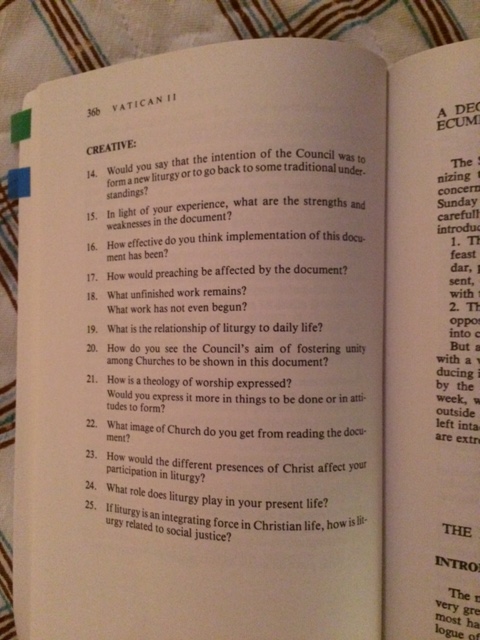
Professed members will discuss the Vatican II document on Divine Revelation,  Dei Verbum  The review questions can be accessed here and here.

We will have Lectio Divina on the readings for the 3rd Sunday of Lent and will conclude by praying Evening Prayer (Vespers) from the Liturgy of the Hours.  A printable file is available here that contains the Magnificat and antiphon already pointed so that it can be easily chanted.

Since this will be the last meeting before Christmas, we will have a white elephant exchange for those who would like to participate.  The gift should be a wrapped Christmas ornament that is under $5.  In addition, any donations from passing the hat around will be donated to one of the local friar’s education fund.  Finally, everyone is invited to bring some snacks for a celebratory potluck.

November 2019 Meeting

Our next meeting will be 2pm on November 9, 2019 in the Faith Formation building at Holy Rosary Parish.

Inquirers can find links to the information that will be reviewed here.

Candidates for admission will continue discussion of the lives of Dominican Saints.

Professed members will discuss the Vatican II document on sacred liturgy, Sacrosanctum Concilium.  The review questions can be accessed here and here.

We will have a discussion on chapter 2 of the book The New Wine of Dominican Spirituality..  We will conclude by praying Evening Prayer (Vespers) from the Liturgy of the Hours.  A printable file is available here that contains the Magnificat and antiphon already pointed so that it can be easily chanted.

Images of the Dominican Rite

Below are a few links with information about the Dominican Rite for those who would like to learn more.

The Dominican Solemn Mass: Pictures and Commentary.

Solemn High Mass in the Dominican Rite celebrated by the Fraternity of St Vincent Ferrer at the Church of the Holy Trinity of Pilgrims in Rome, Feast of St Thomas Aquinas.


Solemn High Mass in the Dominican Rite celebrated for Christmas by friars of the Western Province in the Holy Family Cathedral, Anchorage, Alaska.

July 2019 Meeting

Our next meeting will be 2pm on July 13, 2019 in the Faith Formation building at Holy Rosary Parish.

Inquirers will discuss the Dominican art. More information and the syllabus for the year can be found here.

Candidates for admission will discuss the second third of the book on St Catherine of Sienna.

Professed members will discuss the Vatican II documents on non Christian religions, Nostra Aetate, and on Christian Education, Gravissimum Educationis.

A lecture on Purgatory will be given by Father David Seid O.P.

We will conclude by praying Evening Prayer (Vespers) from the Liturgy of the Hours.  A printable file is available here that contains the Magnificat and antiphon already pointed so that it can be easily chanted.

June 2019 Meeting

Our next meeting will be 2pm on June 8, 2019 in the Faith Formation building at Holy Rosary Parish.

Inquirers will discuss the pillars of Dominican life. More information and the syllabus for the year can be found here.

Candidates for admission will begin discussion of the book on St Catherine of Sienna.

Professed members will discuss the Vatican II document on ecumanism, Unitatis Redintegratio.

A meditation will be given on the readings for the Mass of Pentecost.  We will conclude by praying Evening Prayer (Vespers) from the Liturgy of the Hours.  A printable file is available here that contains the Magnificat and antiphon already pointed so that it can be easily chanted.

Missa Ave Maris Stella

Listen to the Mass setting by Tomás Luis de Victoria.  It will be sung for the Dominican Rite Mass on the Feast of St Lawrence on Auguest 10, 2019 at Holy Rosary parish in Houston.

The Kyrie is sung after the entrance Psalm, called the Officium or Introit.

The Gloria, sung immediately after the Kyrie, recalls the song of the Angels on Christmas.

The Nicene Creed is sung after the Gospel is proclaimed, immediately before the Offertory.

Sanctus and Benedictus are sung together in the Dominican Rite after the Preface and before the Consecration of the Mass.

Agnus Dei is sung after the Our Father and Kiss of Peace, before Communion.